
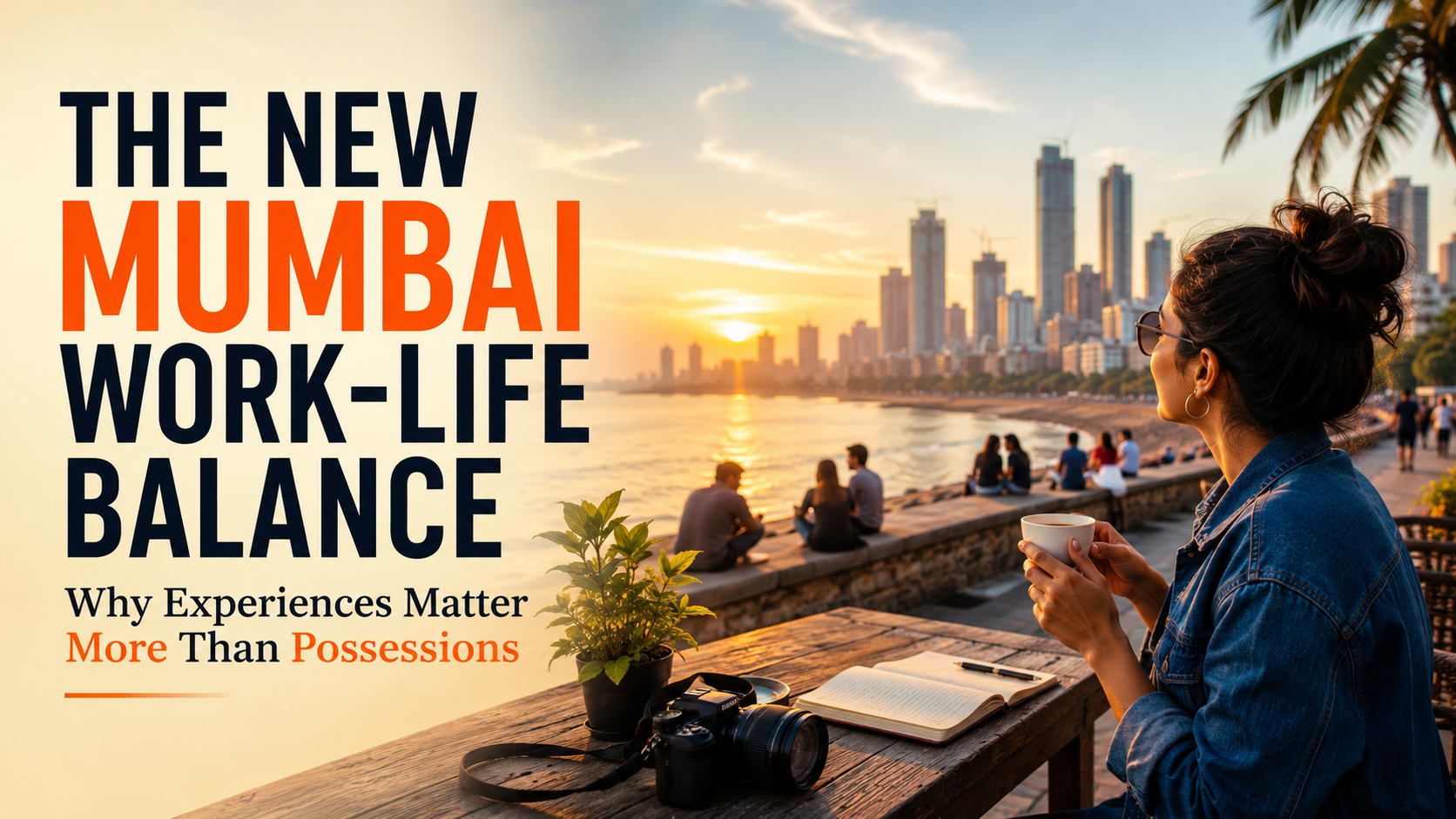
The New Mumbai Work-Life Balance
Why Experiences Matter More Than Possessions
There was a time when success had a familiar checklist.
A spacious apartment. A luxury car parked downstairs. The latest phone. Designer labels. A growing collection of things that quietly announced, “I’ve made it.”
Today, the checklist is changing.
Walk into any café in Bandra on a Sunday morning, and you’ll overhear conversations that have little to do with promotions or possessions. Someone is planning a weekend trek to Matheran. Another is excited about a pottery workshop. A young couple is debating whether to spend on a vacation to Bhutan or finally replace their living room furniture.
Interestingly, the furniture can wait.
The memories cannot.
Somewhere between endless work emails, traffic that tests everyone’s patience, and calendars filled weeks in advance, Mumbaikars are beginning to realise that life isn’t measured only by what we own. It is equally measured by what we experience.
Perhaps this shift isn’t surprising.
After all, Mumbai has always been a city that teaches perspective.
You can see the Arabian Sea shimmering peacefully while thousands hurry to catch the next local train. You can pass luxury residences standing beside century-old neighbourhoods that still celebrate every festival together. The city constantly reminds us that every person’s definition of success is different.
For years, owning more seemed like the natural goal.
Every salary increment was expected to translate into another purchase. A better phone. A bigger television. A newer car.
But happiness, it turns out, has an unusual habit.
It quietly fades once the excitement of buying something new wears off.
The phone eventually becomes ordinary.
The car becomes another vehicle navigating Mumbai traffic.
The excitement settles into routine.
Experiences behave differently.
Years later, we still smile while talking about a surprise birthday trip, an unforgettable concert, a monsoon drive to Lonavala, or an evening spent laughing with friends over cutting chai at Marine Drive.
The experience remains.
The receipt disappears.
That perhaps explains why today’s generation is making different choices.
Many young professionals would rather attend a music festival than spend the same amount on luxury accessories. Families are choosing staycations over extravagant shopping weekends. Parents are spending on learning experiences for their children rather than filling cupboards with toys that lose their charm within weeks.
None of this means possessions have lost their importance.
A comfortable home matters.
Financial security matters.
Owning things that improve everyday life certainly matters.
The difference is that possessions are no longer the final destination.
They are becoming tools for creating a better life rather than symbols of a successful one.
The pandemic accelerated this realisation.
Months spent indoors taught people something that no motivational seminar ever could.
We discovered how deeply we missed simple experiences.
Morning walks.
Family dinners.
Conversations without checking our phones.
Watching sunsets.
Travelling without worrying.
Meeting grandparents.
Celebrating birthdays together.
None of these could be ordered online.
No amount of money could instantly replace them.
That period quietly reset many priorities.
Today, flexible work arrangements have also changed the rhythm of life.
People are no longer waiting only for annual vacations to unwind. They are finding joy in smaller moments—a midweek dinner with friends, cycling on a Sunday morning, attending an art exhibition, volunteering for a cause, or simply reading a book by the sea.
These aren’t grand events.
They are intentional pauses.
And perhaps that is what balance truly looks like.
Interestingly, businesses are noticing this shift too.
Restaurants are designing experiences rather than just menus. Hotels promote wellness retreats instead of room categories. Shopping centres now host art festivals, music performances, and community events because they understand that people seek connection as much as consumption.
Even workplaces are evolving.
Companies increasingly recognise that employee well-being cannot be measured only through salaries. Flexible schedules, mental wellness initiatives, learning opportunities, and meaningful workplace culture are becoming part of the conversation.
People still work hard.
Mumbai probably always will.
Ambition is woven into the city’s identity.
But ambition is slowly becoming more personal.
Success is no longer defined by what impresses others.
It is increasingly defined by what brings peace to ourselves.
Perhaps that is why the most valuable moments rarely involve expensive purchases.
A quiet breakfast before the city wakes up.
Watching rain from your balcony with a cup of tea.
Taking your parents to their favourite restaurant.
Walking along the Worli Sea Face after work.
Listening to an old song during a late-night drive.
None of these moments require luxury.
Only presence.
And presence has become one of the rarest gifts in modern life.
Mumbai will always encourage people to dream bigger, work harder and aim higher.
That spirit should never change.
But maybe the city is gently teaching us another lesson as well.
Collect stories.
Collect conversations.
Collect sunsets, friendships, journeys and celebrations.
Because years from now, very few people will remember the phone they owned in 2026.
They will remember the people they laughed with, the places they explored, and the moments that made them feel truly alive.
And perhaps that is the richest life anyone can build.